Most organizations go through strategy planning every year. Leaders meet, review business performance, discuss priorities, prepare presentations, and agree on targets. A lot of time and energy goes into the process.
Yet in many cases, the strategy does not travel far beyond the meeting room.
The issue is not always the quality of the discussion. Often, the problem is that the business is not being viewed clearly enough. Teams talk about growth, but may not fully understand which customers they are trying to serve. They discuss new products, but do not always test whether the market truly needs them. They set ambitious targets, but may not check whether the current business model can support those targets.
This is where Strategyzer can be useful.
Strategyzer offers practical tools, playbooks, and frameworks that help teams think through strategy, customer needs, business models, growth options, and commercial performance in a structured way. Organizations use these tools to design, test, and improve business ideas before investing too much time, money, or effort in the wrong direction.
Strategy Planning Needs More Than Discussion
Strategy planning is not only about deciding what the organization wants to achieve. It is also about understanding how the organization will create value, serve customers, earn revenue, manage resources, and respond to change.
In many planning sessions, teams spend a lot of time debating opinions.
One person may believe a new product will work. Another may feel the market is not ready. Someone may focus on cost, while someone else pushes for speed. These views are useful, but without a shared structure, the discussion can quickly become scattered.
Strategyzer gives teams a common language.
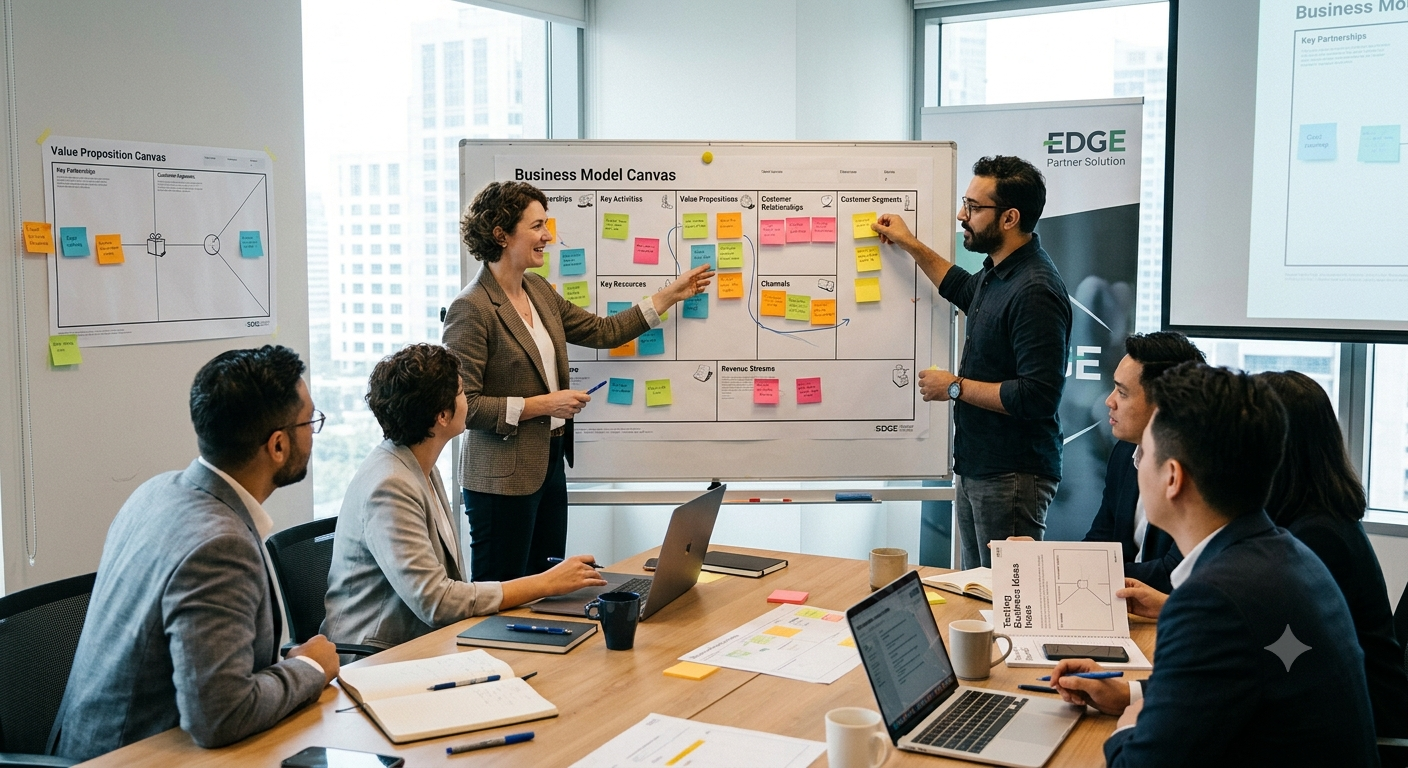
Instead of discussing strategy in broad terms, participants can map the business on a canvas, compare assumptions, discuss choices, and see where the risks are. The conversation becomes more practical because everyone is looking at the same picture.
Seeing the Business on One Page
One of the most widely used Strategyzer tools is the Business Model Canvas. It helps organizations describe, design, question, and adjust their business model.
Instead of relying on long documents that many people may not read in full, the canvas allows a team to see the main parts of the business on one page.
During strategy planning, a leadership team can use the Business Model Canvas to discuss questions like:
- How do we create value for customers?
- Who are our most important customer groups?
- Which channels are working well?
- How do we earn revenue?
- Which activities and resources matter most?
- Where are our largest costs?
- Which partnerships support the business?
Once these questions are placed on one canvas, the team can see whether the strategy is realistic.
For example, a company may want to enter a new market, but the canvas may show that its current sales channels are not strong enough. Another company may want to offer a premium service, but the canvas may reveal that its customer relationship model is not ready for that level of service.
This helps teams move from ambition to practical planning.
Understanding What Customers Actually Need
A strategy may look strong on paper and still fail in the market. One common reason is that the organization has not fully understood the customer’s real problems, expectations, frustrations, and desired outcomes.
The Value Proposition Canvas helps teams design, test, and improve the value they offer to customers. It helps organizations think through whether their products or services actually match what customers need.
During strategy planning, this tool helps teams ask better customer-related questions.
- What problems are customers trying to solve?
- What frustrates them today?
- What outcomes do they want?
- Which parts of our offer reduce their pain?
- Which parts of our offer create real value?
- Where are we making assumptions without enough evidence?
This is useful for existing businesses, new product teams, marketing teams, sales teams, and innovation teams. It helps organizations avoid building plans based only on internal opinions.
When customer understanding becomes part of the strategy conversation, decisions become more grounded.
Testing Ideas Before Committing Resources
Many organizations approve plans based on confidence, seniority, or pressure to move quickly. But confidence is not the same as evidence.
Strategyzer encourages teams to test business ideas and customer assumptions before making large commitments. This approach helps teams reduce risk, learn faster, and make better decisions about growth and innovation.
This is especially useful during strategy planning.
Before launching a new service, entering a new customer segment, changing a pricing model, or investing in a major project, teams can identify the assumptions behind the plan.
They can then test those assumptions through customer interviews, experiments, prototypes, market checks, or other learning activities.
This does not remove all risk. No planning method can do that. But it helps organizations avoid decisions based only on belief, pressure, or internal agreement.
Creating Better Understanding Across Teams
A strategy works only when people understand it and can connect their work to it.
In many organizations, strategy stays at the top. Senior leaders know the direction, but middle managers and employees receive only a summary. Different departments then interpret the strategy in different ways.
- Sales may focus on revenue.
- Operations may focus on efficiency.
- Marketing may focus on positioning.
- Finance may focus on cost control.
- All of these areas matter, but they need to work together.
Strategyzer tools help teams build a shared picture. When people from different functions work on the same canvas, they can see how their decisions affect one another.
A change in customer segment affects the value proposition. A change in value proposition affects channels, resources, activities, cost, and revenue.
This makes the strategy conversation more connected and easier to act on.
Turning Strategy into Action
One of the common weaknesses in strategy planning is the gap between the plan and execution.
Teams may agree on the direction, but they do not always define what needs to be tested, changed, stopped, or started.
Strategyzer helps teams move from discussion to action by making assumptions visible. Once assumptions are visible, teams can decide what to do next.
- They can identify priorities.
- They can assign ownership.
- They can test high-risk areas.
- They can improve the customer offer.
- They can adjust the business model.
- They can review progress with more discipline.
This makes the planning process useful for decisions, not only for documentation.
Where Strategyzer Can Be Used
Strategyzer can support many business situations where an organization needs clarity before making strategic choices.
It can be used for annual strategy planning, business model review, customer value proposition design, innovation planning, new product development, market entry decisions, growth planning, and organizational transformation.
It is also useful when a leadership team wants to question an existing business model, understand customers better, test new ideas, or bring different departments into one structured planning discussion.
- For leadership teams, it brings clarity.
- For functional teams, it creates shared understanding.
- For the organization, it supports better decisions.
Why Facilitation Matters
The tools may look simple, but the real value comes from how they are used.
A Strategyzer session needs proper facilitation. The facilitator has to ask the right questions, guide the discussion, manage different views, and help the team turn ideas into clear choices and next steps.
EDGE Partner Solution has a certified facilitator for Strategyzer-based sessions. This allows organizations to experience the method through a structured and professionally guided process.
Before conducting a session, we work with the client to understand the business context, planning objective, participants, challenges, and expected outcomes. Based on that understanding, we design a session that fits the organization’s need.
The session may focus on reviewing an existing business model, designing a new value proposition, testing a growth idea, preparing for a new market, or improving agreement around strategy.
What Clients Can Expect
Clients can expect a practical and participative strategy planning session.
Instead of only listening to presentations, participants actively map, discuss, question, and refine business ideas. The session helps teams see the business more clearly, understand customers more deeply, and identify the assumptions that need to be tested.
The result is not only a completed canvas.
The real result is clearer thinking, better agreement across teams, and a more practical path for action.
A Better Strategy Conversation Starts Here
Every organization needs to answer difficult questions during strategy planning.
- Where should we grow?
- Which customers should we focus on?
- What value are we really offering?
- How strong is our business model?
- What assumptions are we making?
- What should we test before we invest?
- How do we turn strategy into action?
Strategyzer helps organizations answer these questions in a structured, visual, and practical way.
If your organization is preparing for strategy planning, reviewing its business model, or exploring new growth opportunities, this may be the right time to use Strategyzer.
Contact EDGE Partner Solution to design a Strategyzer-based strategy planning session for your organization. Our certified facilitator will help your team turn ideas, assumptions, and opportunities into a clearer strategy conversation that leads to action.
